In this article for The Daily Star, ABI staff member Anas Ansar explains why the rise of Hindutva politics in the Indian State of West Bengal's recent elections cannot be blamed on Bangladesh.
This second part of a double issue of IQAS (Vol. 56 No. 2) on the epistemic erasure of Afghan women highlights their resistance from within and beyond Afghanistan.
The Arnold Bergstraesser Institute is seeking to fill the position of a Post-Doc Researcher (TVL 13/75%) with regional focus on Sout(East) Asia, starting April 1.
In an interview with Jungle.World, Teresa Jopson shares her expertise on the causes, similarities, and differences between youth movements in Nepal, Bangladesh, the Philippines, Myanmar, and other countries.
This first part of a double issue of IQAS highlights the knowledge, creativity, and critical voices of Afghan women. Women as authors, critics, and theorists are at the center.
Anas Ansar's first monograph, “Rohingyas and the Geographies of Precarity in Exile: Everyday Life in Bangladesh and Malaysia,” has been published in the Bonn Center for Dependency and Slavery Studies series with De Gruyter.
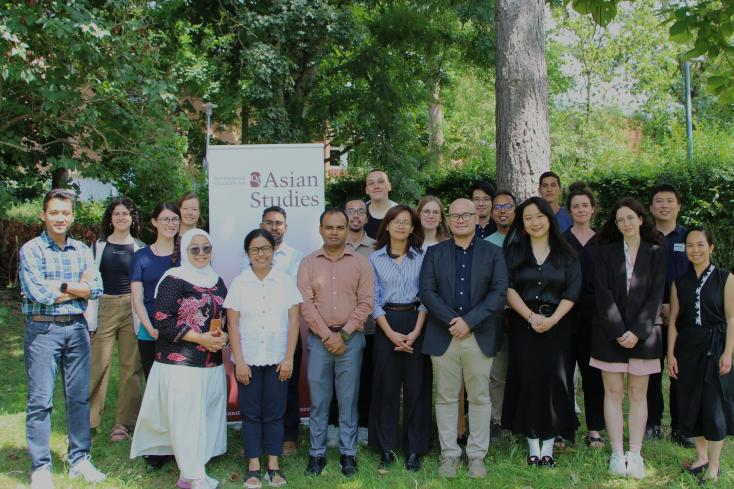
On June 26–27, the ABI hosted an authors’ workshop, bringing together 15 scholars working in and on Asia. The workshop marked a key step towards a special issue of the journal IQAS. The workshop was supported by the Heinrich Böll Foundation (HBS, Brussels).
ABI staff member Anas Ansar and Eva Gutensohn from südnordfunk spoke with activist Azaher Uddín about the young generation in Bangladesh, the possibilities for a new beginning, and what the generation expects of the new government.
The latest issue of IQAS explores the impact of the COVID-19 pandemic on research practices, focusing on the challenges researchers faced while adapting to digitally-mediated research methods.
The latest issue of IQAS offers diverse perspectives on key societal and political issues in Thailand, Japan, Indonesia, and China.